
[Dr. Gyu’s Precision Guide] Can bone-conduction headphones still affect your hearing?
English editorial edition by the SoundPill team, based on the original Dr. Gyu article. Updated 6 November 2026 against the sources below. This edition does not establish that one headphone type is safer for everyone.
Can bone-conduction headphones affect your hearing even though they leave your ears open?
Bone-conduction headphones leave the ear canals open and transmit vibration through the head. They still involve the cochlea, the hearing organ in the inner ear. An open-ear design therefore does not make the inner ear immune to excessive sound exposure.
1. A different route to the inner ear
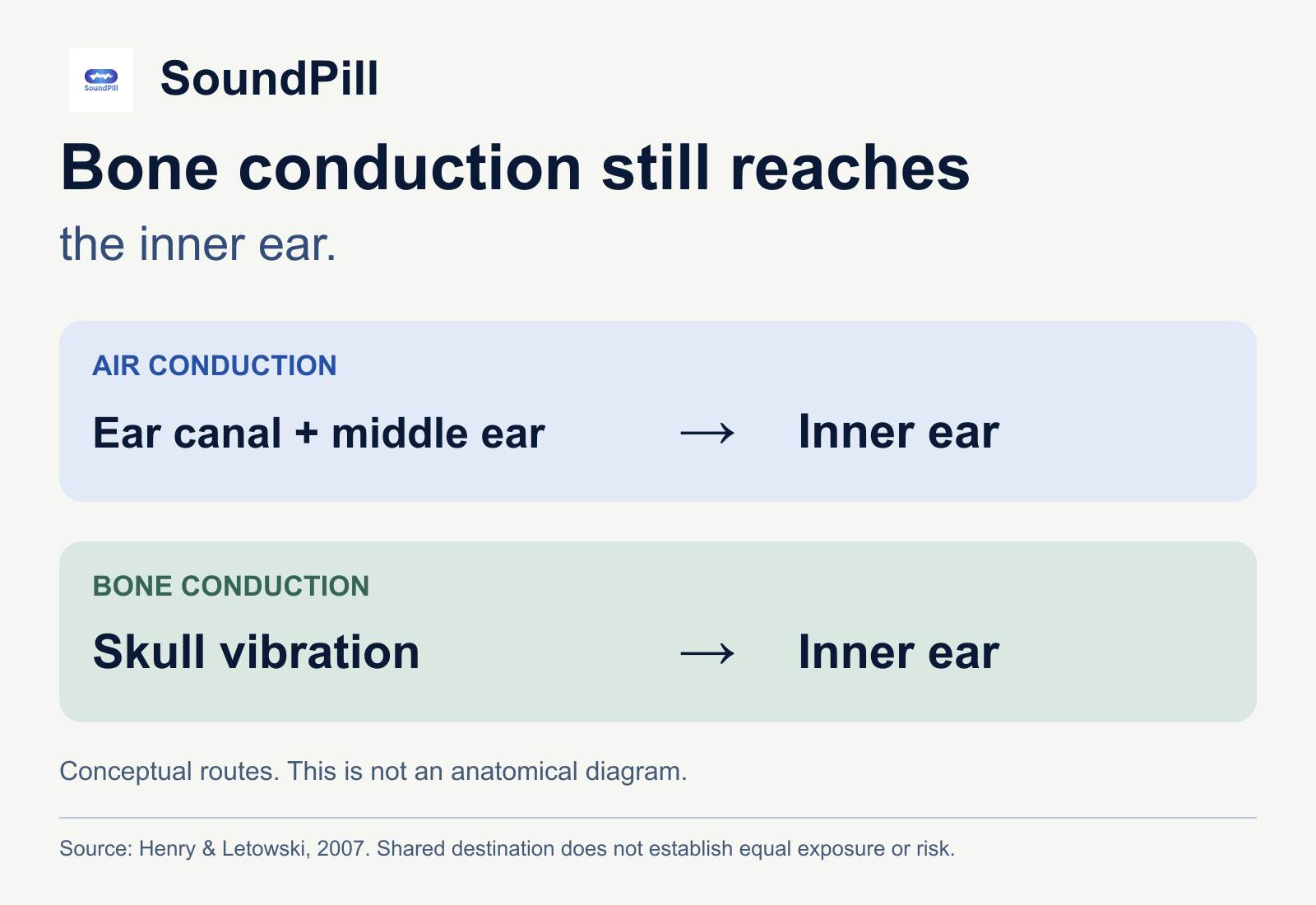
With ordinary air-conduction earphones, sound travels through the ear canal, eardrum and middle-ear bones. Bone-conduction devices use a different transmission route that can bypass the outer and middle ear. Both routes can stimulate the cochlea.
Henry and Letowski’s technical report explains these pathways. It does not show that every air- and bone-conduction device delivers equal energy or has equal long-term hearing risk. A volume-slider position alone cannot establish that comparison.
Loud sound can damage sensory hair cells in the inner ear and cause permanent hearing loss. Very intense sounds can also injure other ear structures.
2. Open ears in a noisy setting
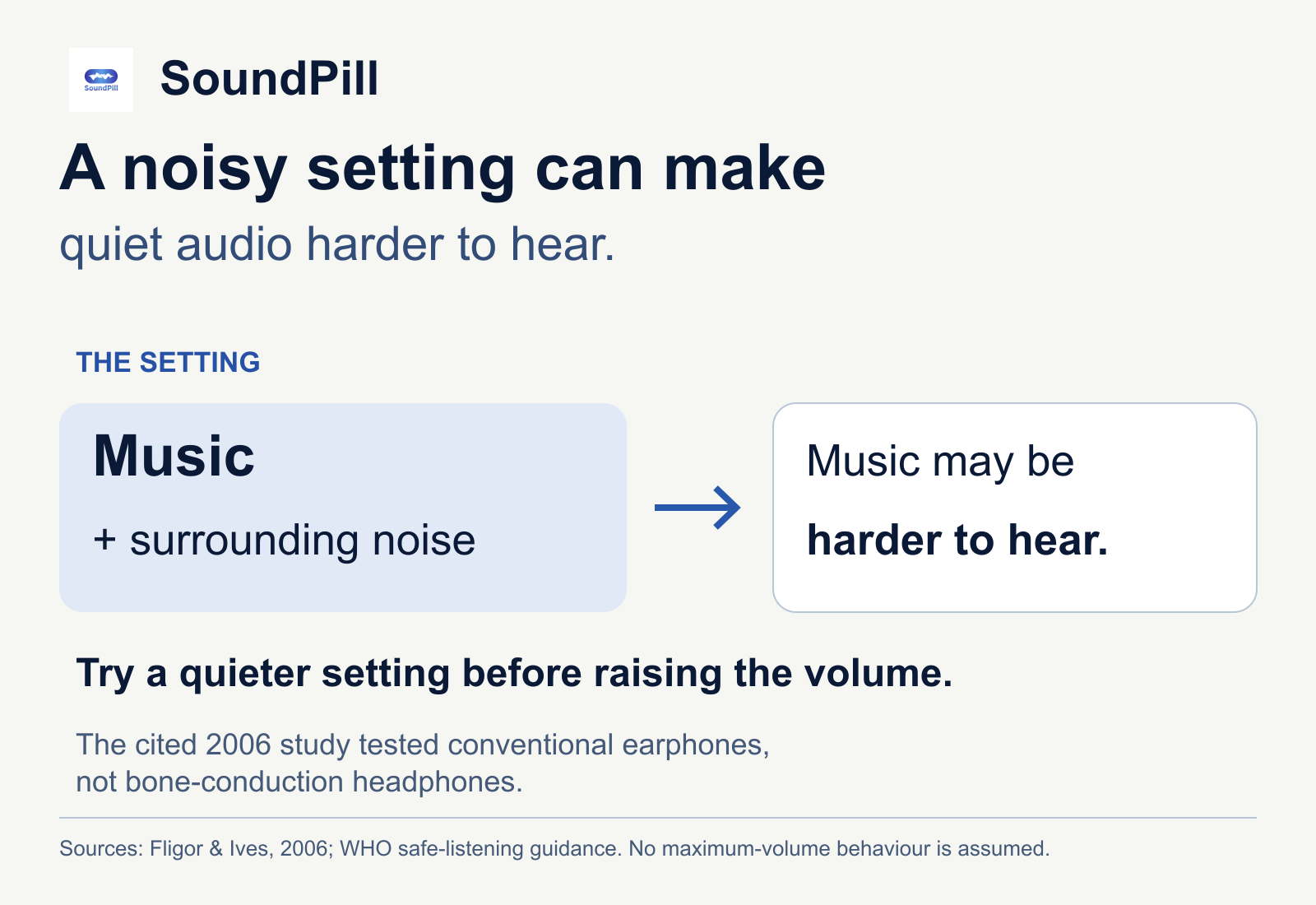
Background noise can make music harder to hear and can prompt listeners to choose a higher playback level. This is a reason to consider the listening environment, rather than assume an open-ear device will always be comfortable at the same setting.
Fligor and Ives’ 2006 conference report studied 100 normal-hearing doctoral students using four conventional earphones. Selected music levels varied with background noise and passive isolation. The tested models did not include bone-conduction headphones. This study did not measure new hearing loss or establish that listeners unconsciously turn bone-conduction devices to maximum volume.
3. Level and exposure time matter
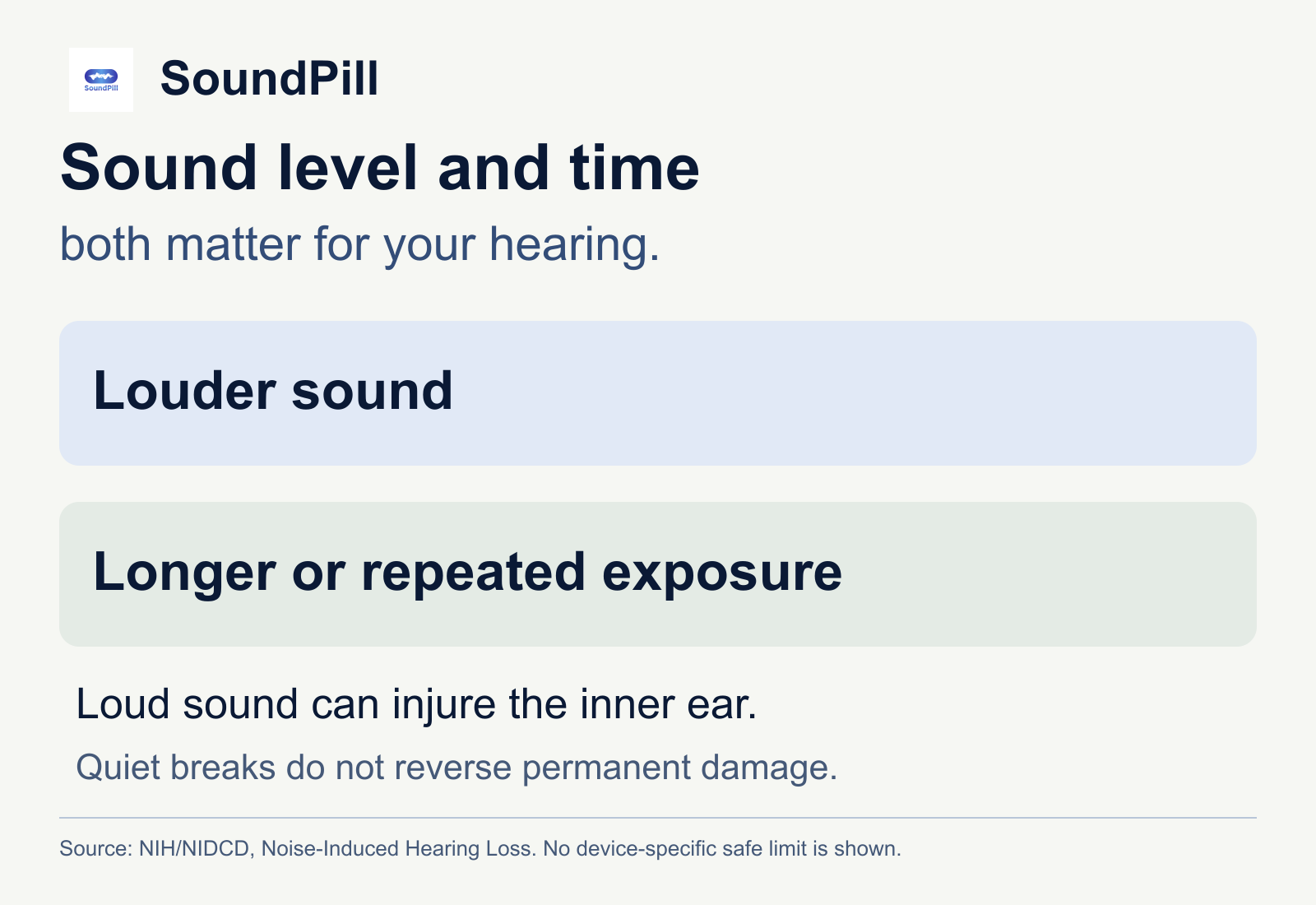
Noise-related injury can involve several physical and biological processes. The practical point for everyday listening is that louder sound and longer or repeated exposure increase hearing risk. Human sensory hair cells do not normally regrow after they are destroyed.
Quiet breaks reduce further exposure. They do not reverse permanent injury.
4. A practical listening check
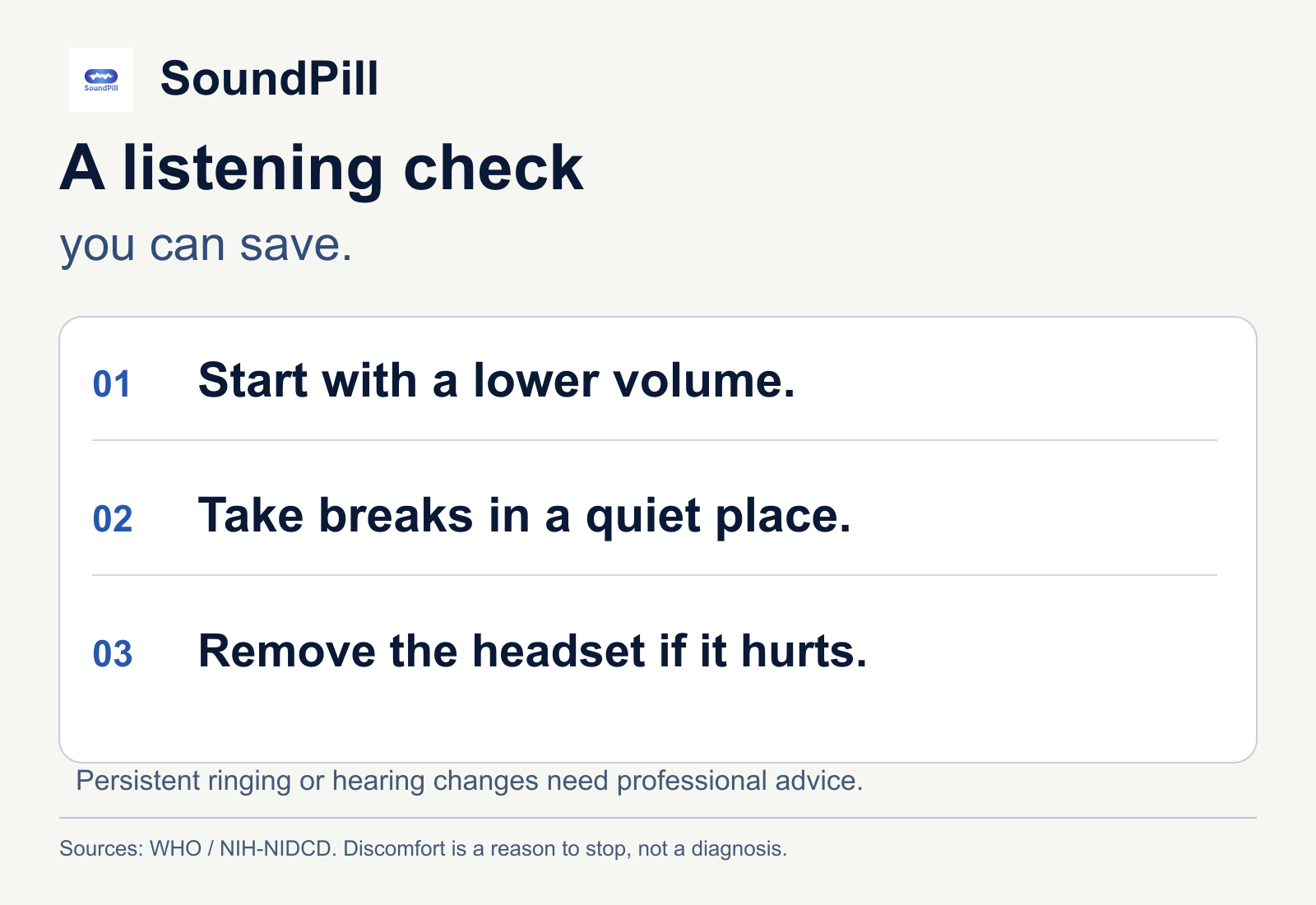
- Begin at a lower setting. Readjust in a quiet place. A familiar percentage does not guarantee the same output from a different headset.
- Reduce the need to turn music up. Well-fitted noise-cancelling headphones can reduce the need to turn music up in noisy settings. The sources checked for this edition do not establish superior long-term hearing protection for every ANC device.
- Track time and take quiet breaks. A percentage or a fixed 60-minute interval alone cannot establish a universally safe listening dose.
- Remove a headset if it causes pain or a headache. Pain or a headache is a reason to stop, not a diagnosis. Persistent ringing or changes in hearing warrant professional advice.
Takeaway: Choose a listening setup that helps you keep the level low and avoid prolonged loud exposure. The device category alone cannot certify safety.
Sources checked for this English edition
- Henry, P., and Letowski, T. (2007). Bone Conduction: Anatomy, Physiology, and Communication. Army Research Laboratory. Technical account of transmission pathways; not a consumer hearing-loss trial.
- NIH / NIDCD: Noise-Induced Hearing Loss. Public guidance on sound exposure, inner-ear injury and prevention.
- Fligor, B. J., and Ives, T. E. (2006). Does Earphone Type Affect Risk for Recreational Noise-Induced Hearing Loss? Conference report on chosen listening levels using four conventional earphones; bone-conduction devices were not tested.
- WHO: Deafness and hearing loss — Safe listening (6 March 2026). Practical exposure guidance, not a guarantee for an individual listener or device.

© 2025 Digital Nutrition Co., Ltd. Unauthorized reprinting and reproduction are prohibited.
All contents are protected by copyright law. Unauthorized reproduction or redistribution is prohibited.
Supporting a healthier everyday life with SoundPill, informed by medical evidence!

For a restful night: EasyRest, a chewable you can take before bed without water.

| Number | Title | Author ID | Date Created | Like | Views |
| 59 |
Same 30% volume. Why are these earbuds louder?
DN
|
2026.11.06
|
Like 0
|
Views 155
|
DN | 2026.11.06 | 0 | 155 |
| 58 |
ASMR or white noise? Why rain recordings get both labels
DN
|
2026.11.05
|
Like 0
|
Views 146
|
DN | 2026.11.05 | 0 | 146 |
| 57 |
[Dr. Gyu’s Precision Guide] Can bone-conduction headphones still affect your hearing?
DN
|
2026.11.05
|
Like 0
|
Views 167
|
DN | 2026.11.05 | 0 | 167 |
| 56 |
White, pink and brown noise: how to choose what to listen to
DN
|
2026.11.03
|
Like 0
|
Views 185
|
DN | 2026.11.03 | 0 | 185 |
| 55 |
EasyRest pop-ups and the story behind the third production run
DN
|
2026.10.28
|
Like 0
|
Views 255
|
DN | 2026.10.28 | 0 | 255 |
| 54 |
User story 16: “I wish I’d eaten less” and appetite control with SoundPill
DN
|
2026.10.22
|
Like 0
|
Views 307
|
DN | 2026.10.22 | 0 | 307 |
| 53 |
Cat purrs, singing bowls, and the science of vibration
DN
|
2026.10.07
|
Like 0
|
Views 401
|
DN | 2026.10.07 | 0 | 401 |
| 52 |
Bringing SoundPill to a community mental health center in Eunpyeong
DN
|
2026.09.30
|
Like 0
|
Views 410
|
DN | 2026.09.30 | 0 | 410 |
| 51 |
User story 15: Still at the laptop after the Zoom call ends
DN
|
2026.09.29
|
Like 0
|
Views 447
|
DN | 2026.09.29 | 0 | 447 |
| 50 |
Market feedback from the exhibition floor
DN
|
2026.09.02
|
Like 0
|
Views 594
|
DN | 2026.09.02 | 0 | 594 |
 English
 Korean